
interrogating online identity
how the internet shapes our self-schemas and why we need to self-reflect to actually overthrow capitalism.

what it means to be chronically online
I have caught myself having iPad baby moments and am tremendously embarrassed by my screen time. I’ll leave it at that. But it is enough that I would consider myself chronically online. I find that I am often the one sending links in my messages to friends and family for posts that remind me of them, the one that people always ask to translate slag or trends, the one that loves to talk about whatever new thing Trisha Paytas is up to whenever given the opportunity.
I’m not alone either. If you are reading this, you are a part of the 311,300,00 Americans (91.8% of the population) that use the internet. 85% of which go online daily, and possibly you are a part of the 44% of 18 to 49-year-old users who self-reported that they are online “almost constantly.” Among this group, millennials and zoomers are likely aware of this emerging term of “chronically online” and possibly relating to the label themselves with the modern need to be online for school, work, or personal communication. Some users go even further, labeling themselves a NEET (Standing for Not in Education, Employment, or Training. See video below) with pride as they spend their day tiptoeing around piles of dishes and computer parts scrolling message boards. Others dedicate their lives to trolling lolcows, often autistic people who are not fully aware of the manipulation occurring. For good and bad, the chronically online user population is here and growing.
If you don’t already have a working definition the top one provided by the chronically online users of urbandictionary is perfect: “Someone who is basically always on the internet and their entire existence revolves around being on the internet.” Although “their entire existence revolves around… the internet” is arguable semantically, the core of this definition is that someone who is chronically online has an offline identity that is inseparable from their online identity, shaped by and shaping their constant online presentation of identity.
a (condensed) history of the internet
I want to preface this section by saying that nearly everything in this section I have learned from Yasha Levine’s Surveillance Valley. Highly recommend the read. I am including this although it may seem irrelevant as I believe it is vital to consider the original context in which the internet was created when analyzing its modern purpose and affordances – and understanding the online American State as a sculptor of identity.
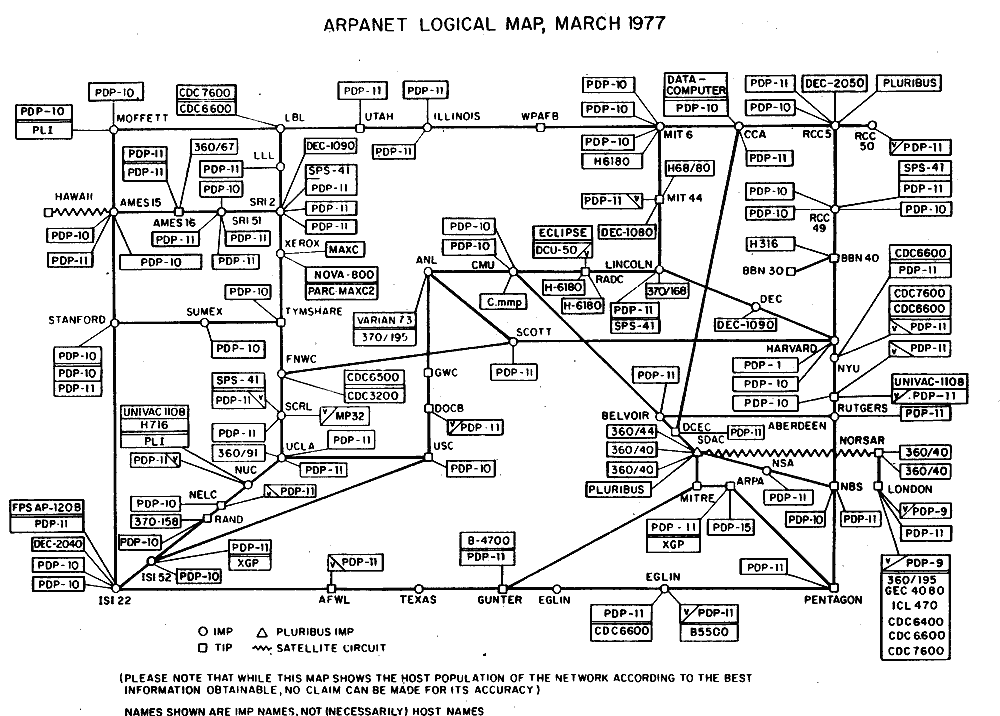
The internet that we use today was created explicitly in the name of American imperial interests. The Advanced Region Projects Agency was created at the hands of Dwight D. Eisenhower immediately following the historic launch of Sputnik 1 in 1958. ARPA was explicitly tasked with developing cutting-edge technologies to comfort American officers and administrators that their military might would always outpace that over that of the dirty Soviet communists. ARPA originally focused on space technologies, ballistic missile defense, and nuclear test detection systems. However, with the parallel funding of NASA directing most space race progress there was a revolving door of directors until Jack Ruina, an electrical engineering professor from MIT, was brought on as director in 1961. He hired J. C. R. Licklider, a trained psychologist and computer scientist who would be the pioneer of the internet. It was around this time that ARPA began to expand into “high risk high reward” research, bolstered by a network of universities eager to receive grants and be at the forefront of research and development for national “defense.” Project AGILE launched as an early form of counterinsurgency work and early modern state surveillance was born. Research was included to include psychology and the behavioral sciences as a response to the perceived mysticism of communism. They created GPS, too.
In 1969, four years after the United States sent the first wave of combat troops to land in South Vietnam, ARPANET was created within ARPA. At Lick’s direction (yes that was his nickname) ARPANET was made a reality when Bob Taylor (Naval reservist and psychology PhD) tasked Larry Roberts (3x MIT Degree holder, PhD in electrical engineering) with engaging universities to create initial protocols and packet networks for file sharing and remote operations. The first computers were connected in 1969, protocols were implemented in 1970, and in ‘71 DARPANET was officially operating (and renamed to add “Defense Agency” for the first two letters). DARPANET did expand on ARPANET though, essentially connecting multiple ARPANETs globally supplemented by information from other sources such as radio or satellite data. DARPANET marked the beginning of email as close to real-time messaging was essential to keep up on sharing information gathered from the surveillance of Viet Cong fighters on the other side of the planet. Surveillance happened at home, too. Throughout the early 70s the army was caught with paper trails of surveillance on civilian “counterinsurgents” and harshly criticized. Rather than fully destroy the files officers opted to move the information to DARPANET for storage and destroyed the physical files.
Parallel to these military developments, private capital was growing and hungry. As public use of computers increased (think uses of IBM and banking systems to automate payroll) independent funding entered the scene to see how previously developed technology could be mass-consumed. Silicon Valley was already a central point for the production of and mainseller to the U.S. Government of computer chips and other parts. The primary investor in early private tech firms was the Pentagon – directly and through front groups. In pursuit of short-term profits, DARPA developments are quickly rolled out to the everyday consumer without oversight or regulation. At the time, it was mostly state officials and academics online. Security for the average citizen was not a concern. The State has always and will continue to take advantage of this systemic affordance.
building online identity
I made my first stan account in 2012 at nine years old. I posted Animal Jam fanart and OCs for a few months before switching to a Good Mythical Morning fanpage and quickly became “multifandom” to include online creators like danisnotonfire, AmazingPhil, and Markiplier. As a bit of a “weird” kid longing for social acceptance after losing my first close friends I found a home in an app. Mutuals were genuine friends, people who gave me a sense of belonging. As a baby queer, I messaged many of those group-run LGBT accounts that reposted gay Tumblr classics for advice on how to live in a homophobic family. I confessed my desire to cut my hair and bind my chest to a total stranger. Then my mom went through my iPad while at school and my world came crashing down. In denial I began falling down the alt-right pipeline, trying to force myself to fit into the box I was “supposed to” But I kept coming back to my stan circles. They were my home, after all. And the people there supported me no matter what – even if they were just strangers on the other side. I consider my childhood to be one shaped by my existence online, and to this day I still have a stan account and consider the internet central to my sense of identity.
There are two different versions of the “self” that is theorized in Western psychology. The “I” self exists as a subject; one is their perceiver, thinker, and actor. The other, “me”, is seeing the self as an object in your self-consciousness. This is an explicitly white cishet male definition. One which ignores how the self and “the other” have been intertwined throughout history and are inseparable from racialized and queer bodies – especially when at the same time Western psychologists hold self-esteem as an implicit personality indicator of social standing. Black psychology explores the sense of self as one that is intertwined with reality and history, “recognize that there is no universal psychiatric reality and that, …the only valid perspective is one that reflects the culture of the people served.” Wade Nobels explains that self-consciousness (and therefore identity) is reflected in the recognition that one is living in a reality with parts of themselves pitted against parts of society. For African Americans, a population that is disproportionately online, he explains that the construct of the Black self is rooted in the white supremacist “master/slave” dynamic that characterizes the history of Black America. Black Psychology has ensured that material reality is an objective factor in the development of the self. This redefined structure of the self is applicable and more inclusive of individuals who aren’t straight white men who similarly live in states of double consciousness between their internally known self that is battling with the societal perceptions of the self.
“Finally, there was a space... that allowed me to be me. I could be black and it was okay. I could be a woman and it was ok. I could be a dyke and it was really ok. Now if I could find a way to make that happen in real life, I’d be one happy bitch.”
- Kina, Dom, 21
One of my favorite studies on online community looks at black lesbians gaming on Xbox Live. Besides it being joyful to read the experiences of fellow out gaymers as a butch gaymer, this piece encapsulates what it means for minoritized “selves” to maintain their identity online. Kishonna Gray accounts that out and proud studs, stems, and fems, still found community amongst each other online in the same way they do offline. In a beautiful continuation of the butchfemme dynamic studs would unapologetically occupy space and defend femmes from male harassment. Ironically often using their status as a man being dogshit at a video game compared to a black lesbian with a hotter girlfriend than him against men who were attacking.
I know that my experience as well as the ones described by Gray are interconnected and not isolated. For black, brown, queer, and trans people the internet has served as a place of both community and discrimination. Being online allows for community discourse that would be impossible to have at scale in reality. I know trans people who learned how to create their hormone replacement therapy from guides written online by other trans people. Black Twitter is an institution of the black community, and the social process of trends created by black queer people in their spaces being appropriated by and spreading through the mainstream replicates itself as it occurs offline. Our lived experiences prove that the self is shaped by material realities that replicate through our behaviors online that are an extension of our identity. In a growing number of cases, that identity is an expression of one’s online and offline self that is constantly shaping and shaped by how one and the world around them interact.
The internet is now an intrinsic tool for how individuals shape their identity. Of course from discourses in communities they belong to, but additionally be it from following creators, shopping for the trendiest clothes, or even something as simple as liking a post. These are all expressions of one’s online identity – the online manifestation of one’s self-consciousness.
As an additional social sphere, online interactions and identity can serve as a form of cultural capital. Those with more followers are subconsciously placed higher than mr. nonamebunchofnumbers. Online trends make themselves into the real world. Stanley cups aren’t bound to TikTok but rather populate shelves and show up as ads on other platforms. They become conversations, items of status, and items of envy.
but is it really our identity?
It is an objective fact that the algorithms that rule our online lives are fascist; misogyny and transphobia, homophobia, and racism are ingrained in every operating system. Websites and social media apps are designed to take advantage of the way our minds work. Little “nudges” are provided to tell us “what we want” when using a platform. Even the way an interface is designed is intentional, some even take advantage of laws of psychology to make buttons the “most efficient” to click.
All of this leaves a lingering question – how much of our identity, when it is so intertwined with the internet, is ours? I write this not as a denial of one’s ownership and authority of identity, but to rather interrogate how identity is shaped by online state surveillance and capitalism and how to fight those reflections in ourselves.
Pierre Bourdieu theorized that cultural capital reflects the interests of the bourgeois, legitimizing their control of economic capital out of “respect” for their knowledge. At the same time, this process obscures the basis on which the capital holders are “entitled” to their status as the idea of what is culturally valuable is entirely subjective. Here, there is a clear basis for proletarian resistance through the means of challenging culture. Therefore class struggle exists beyond the economic realm and must be fought in the social realm as well. One’s taste and idea of valuable cultural capital is based on their offline material reality but are reflected in the online space as well – online identity is a direct reflection of perception of material reality. Online the algorithm can be considered a vague “material” basis of the internet. Given this and the points expanded on previously, three connections and a call to action become clear when using the internet as a case study medium for interrogating the formation of identity under American capitalism:
The base of the material world, online and offline, is built on and intended to preserve American imperial interests. From the birth of the modern internet for the explicit purpose of fighting communists abroad and black liberation domestically to the systemic racism and other discrimination that manifests in algorithms created by and for the bourgeois, and
Economic capital is the driver of internet use. When not online for work or school the user is the product, their online identity is manipulated to continue to target as a consumer or data sold for profit, and
A unique affordance of online spaces is that communities, especially those of black, brown, queer, and otherwise marginalized communities have a place to gather that is on the same level as the “elite.” The ease of socialization allows for emotional connection as well as a source of attaining cultural capital where the lines of cultural hierarchy are blurred. In the online, it is easier to confront what it socially means to subconsciously reproduce the current capitalist order in the offline, therefore
Socialists have an explicit duty to continue the interrogation of their “self” for ways that they are subconsciously reproducing the immaterial social needs of the American bourgeois to combat capitalism within ourselves. Without engaging with the sociocultural and personal aspects of class struggle, economic liberation alone will fall short of successfully challenging the dominant forces of global late-stage capitalism.